Understanding Freemasonry in the Context of Early Scientific Societies
Freemasonry, often shrouded in mystery and intrigue, has played a significant role in the historical development of various scientific societies. Emerging in the late 16th to early 17th centuries, Freemasonry offered a unique blend of social networking and intellectual pursuit that attracted many of the era’s leading thinkers. This article explores the intersection of Freemasonry and early scientific societies, highlighting how these organizations influenced one another and contributed to the broader landscape of knowledge during a time of great change.
The Origins of Freemasonry
Freemasonry traces its roots to the guilds of stonemasons in medieval Europe. By the 17th century, these guilds began to accept members who were not craftsmen, thus transforming into a fraternity focused on moral and philosophical ideals. The establishment of the first Grand Lodge in London in 1717 marked a pivotal moment for Freemasonry, as it formalized the structure and rituals that would define the organization. This period coincided with the Enlightenment, a time when reason and scientific inquiry began to challenge traditional doctrines, creating fertile ground for the rise of scientific societies.
The Enlightenment and Its Impact on Scientific Inquiry
The Enlightenment was characterized by a surge in intellectual activity, as thinkers like Isaac Newton and René Descartes laid the groundwork for modern science. Freemasonry, with its emphasis on reason, morality, and the pursuit of knowledge, attracted many Enlightenment figures who were eager to discuss and disseminate new ideas. The Masonic lodges became venues for scientific discourse, where members could share findings and debate theories in a supportive environment. This collaboration among members often led to significant advancements in various scientific fields, including physics, chemistry, and astronomy.
Freemasonry’s Role in the Establishment of Scientific Societies
Many early scientific societies were founded by Masons who recognized the need for organized forums to promote scientific research and collaboration. For example, the Royal Society of London, established in 1660, included several prominent Freemasons among its founding members. The society became a model for similar organizations across Europe and America, fostering a culture of systematic observation and experimentation. The Masonic principles of brotherhood and knowledge-sharing helped shape these societies, encouraging members to pursue scientific inquiry while upholding ethical standards.
Notable Freemasons in Science
Throughout history, numerous influential scientists were also prominent Freemasons. Benjamin Franklin, one of the Founding Fathers of the United States, was an active Mason who used his lodge as a platform for discussing scientific ideas. His experiments with electricity and contributions to the understanding of meteorology were groundbreaking and exemplified the Masonic commitment to inquiry and progress. Similarly, figures like Sir Isaac Newton and Charles Darwin had ties to Freemasonry, indicating the organization’s significant influence on the scientific community.
The Intersection of Art and Science in Masonic Thought
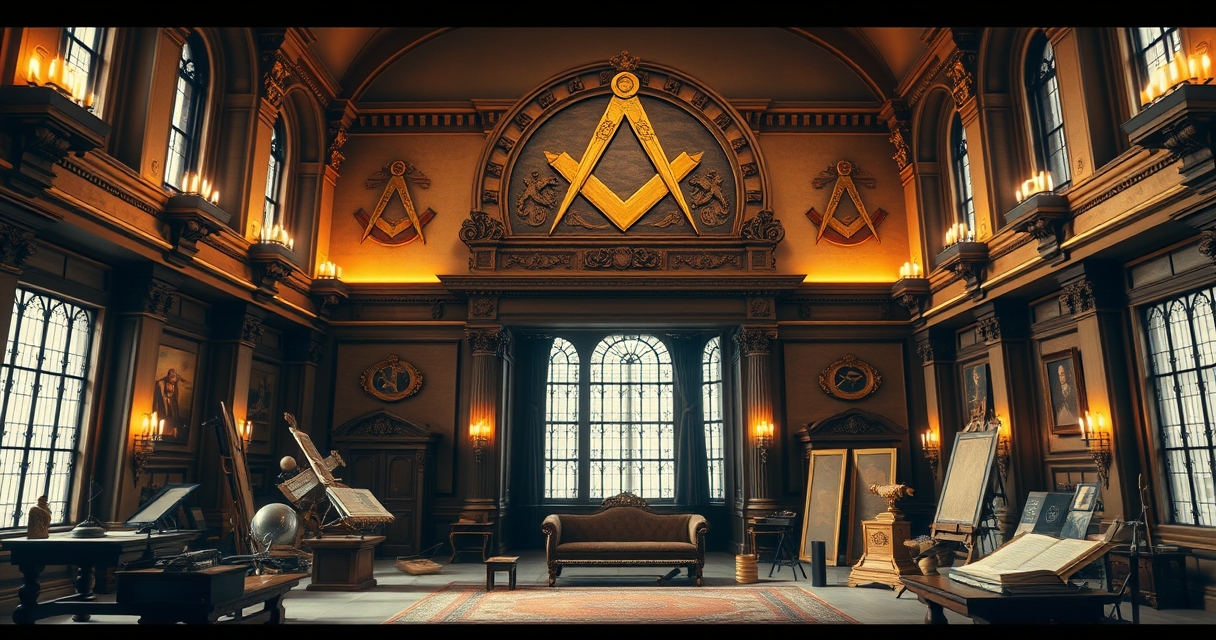
Freemasonry’s influence extends beyond science into the arts, reflecting a broader cultural movement that valued creativity and intellectual exploration. Masonic teachings often emphasized the importance of beauty, harmony, and the interconnectedness of all knowledge, which resonated with artists and scientists alike. This intersection fostered a collaborative spirit, leading to innovations in both fields. For instance, architects and artists who were Masons contributed to the design of iconic structures, integrating scientific principles with artistic vision, thereby enriching the cultural landscape of their time.
Challenges and Criticisms of Freemasonry
Despite its contributions to science and society, Freemasonry has faced criticism and skepticism throughout its history. Some have viewed it as a secretive organization with undue influence over political and scientific matters. Conspiracy theories often surrounded Masonic gatherings, leading to public distrust and misconceptions. In the 18th century, anti-Masonic sentiments surged, particularly in America, where opponents claimed that Masons sought to undermine traditional values and institutions. These challenges prompted Freemasons to clarify their mission and emphasize their commitment to enlightenment principles and the betterment of society.
Legacy of Freemasonry in Modern Scientific Societies
The legacy of Freemasonry can be seen in the structure and ethos of many contemporary scientific societies. The emphasis on collaboration, ethical standards, and the pursuit of knowledge continues to resonate in organizations dedicated to scientific advancement. Today, many scientific societies uphold the ideals that were championed by Freemasons, fostering environments where diverse ideas can flourish. The spirit of inquiry that characterized the Enlightenment and early scientific societies remains integral to the mission of these organizations, ensuring that the pursuit of knowledge is a shared endeavor.

I have spent the past decade exploring the intersections of Freemasonry, art, and science, researching historic manuscripts and architectural symbolism. My work as a freelance writer and independent researcher allows me to share the rich history of knowledge that these traditions embody.