
The intersection of theoretical physics and visual art has always been a fertile ground for innovation, but the influence of quantum mechanics on contemporary abstract sculpture and installations represents a particularly compelling development in quantum art and modern sculpture trends. Artists are increasingly drawn not to illustrating quantum phenomena directly, but to embodying their underlying principles, uncertainty, superposition, entanglement, through form, space, and material. This approach moves beyond mere representation and delves into the experiential, seeking to create artworks that resonate with the counterintuitive logic of the quantum world, challenging our perceptions of reality and physicality.
Embracing Uncertainty: Sculptures of Ephemeral Form
One key principle artists explore is Heisenberg’s uncertainty principle, which states that certain pairs of physical properties, like position and momentum, cannot both be known with perfect accuracy. This translates into sculpture through the use of transient materials or designs that appear to shift and change depending on the viewer’s perspective. Works by Cornelia Konrads, for example, often appear to defy gravity, seemingly floating or bending space, creating a visual sense of instability and unknowability. This isn’t about replicating a quantum state, but evoking the feeling of inherent indeterminacy, mirroring the probabilistic nature of quantum events. The deliberate use of balance and precariousness highlights the fragility of perceived reality, prompting contemplation on the limits of observation.
Sculptors working with light and projection, like James Turrell, also tap into this idea of uncertainty. Turrell’s light installations manipulate our perception of space and form, making it difficult to pinpoint boundaries or define the physical properties of the environment. The experience is less about seeing something concrete and more about becoming aware of the process of perception itself. This resonates with the quantum concept that observation fundamentally alters the observed, a subtle but profound connection that encourages a more active and questioning engagement with the artwork. The ephemeral nature of light further reinforces the idea that reality is not fixed but constantly in flux.
Superposition and Multiplicity: Installations of Concurrent States
The quantum principle of superposition, where a particle can exist in multiple states simultaneously until measured, finds expression in installations that present multiple possibilities or fragmented realities. Artists might employ multiple projections, layered forms, or mirrored surfaces to create a sense of overlapping dimensions, suggesting that different states of being can coexist. Anish Kapoor’s large-scale, mirrored sculptures, such as ‘Cloud Gate’ in Chicago, demonstrate this well. The distorted reflections create a multiplicity of perspectives, challenging the viewer’s sense of self and spatial orientation, and mirroring the way a quantum particle occupies several states at once. The artwork isn’t a single, fixed object, but a dynamic interplay of perception and reflection.
Another approach involves the use of algorithmic or generative art, where artworks are created through processes that explore numerous potential outcomes. These artworks often appear complex and unpredictable, mirroring the inherent complexity of quantum systems. By relinquishing complete control over the final form, artists allow for chance and emergence to play a role, resulting in sculptures and installations that feel both deliberate and spontaneous. This echoes the probabilistic nature of quantum events, where outcomes are not predetermined but arise from a range of possibilities.
Entanglement and Interconnectedness: Sculptures in Relational Space
Quantum entanglement, the phenomenon where two particles become linked and instantaneously affect each other regardless of distance, inspires artworks that explore interconnectedness and relationality. Sculptures might be designed as interdependent systems, where the movement or alteration of one element directly impacts others, even if they are physically separated. The work of Olafur Eliasson frequently engages with this idea, utilizing natural phenomena like light and water to create immersive environments that highlight the interconnectedness of the viewer, the artwork, and the surrounding space. His installations often rely on subtle interactions and shifts in perception, evoking a sense of holistic connection.
In-Public: Explaining quantum concepts through fine art
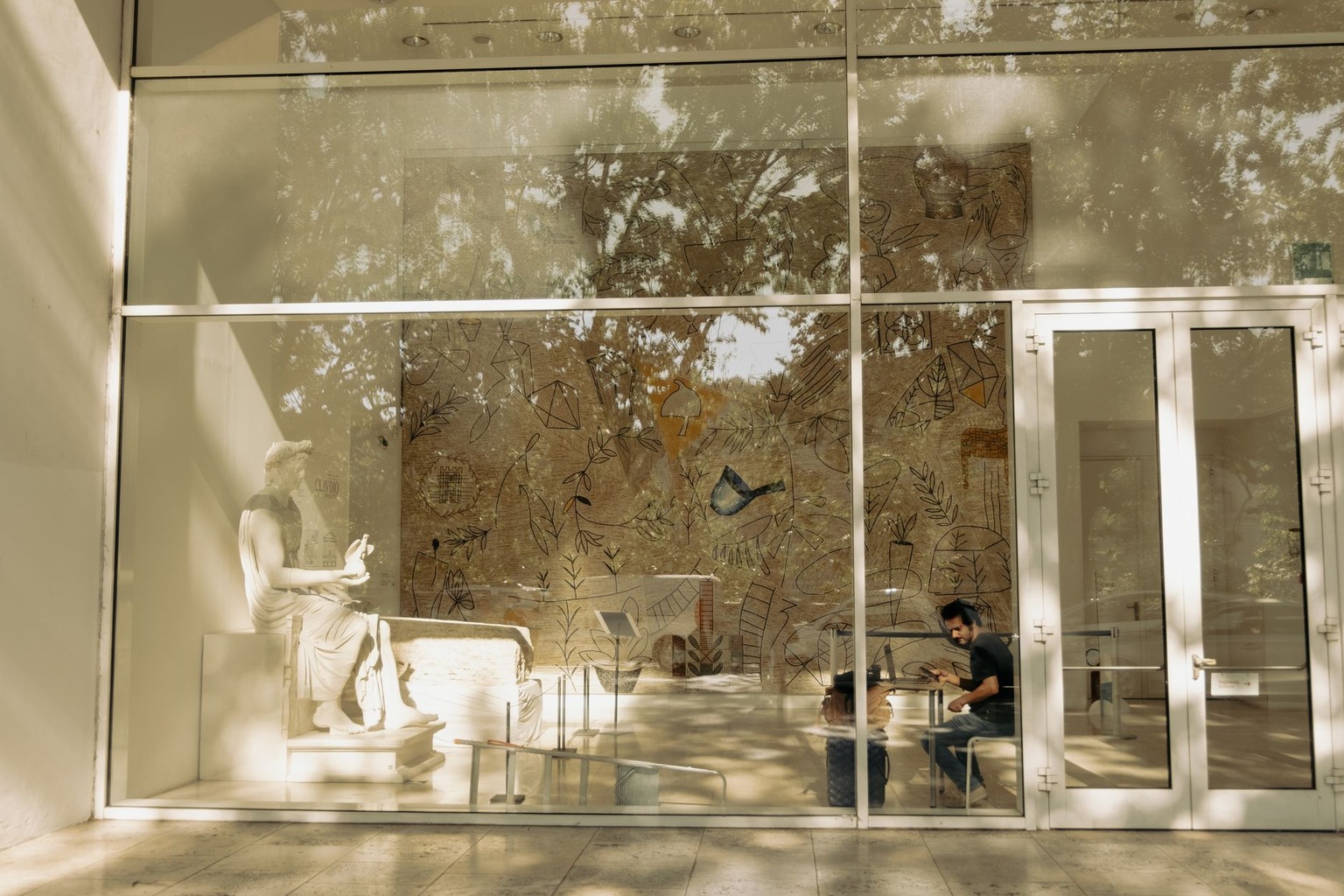
Installations involving networked sensors or interactive technology can also embody entanglement. When a viewer interacts with one part of the artwork, it triggers a response in another, creating a sense of non-local connection. This type of work moves beyond the purely visual and engages the viewer as an active participant in the artwork’s unfolding, mirroring the way entangled particles influence each other’s states. It’s a deliberate attempt to translate a fundamental quantum property into a tangible and experiential form.
Materiality and the Quantum Vacuum: Sculptures from Nothingness
The concept of the quantum vacuum, the idea that even empty space is filled with fluctuating energy and virtual particles, has led artists to explore the potential of seemingly ‘empty’ or minimal forms. Sculptures that utilize negative space, transparency, or ephemeral materials can evoke this sense of underlying energy and potential. Artists like Rachel Whiteread, known for her casts of spaces, are particularly relevant here. Her sculptures capture the absence of objects, highlighting the shape of the void and suggesting the presence of something unseen, much like the virtual particles that momentarily pop into and out of existence in the quantum vacuum. This challenges traditional notions of form and substance.
Another approach involves using materials that are inherently unstable or prone to change, such as ice, salt, or organic matter. These materials undergo constant transformation, mirroring the dynamic fluctuations of the quantum vacuum. The sculptures are not static objects but rather processes of becoming, highlighting the impermanence of all things and the underlying energy that drives change. They remind us that even seemingly empty space is teeming with potential and activity.
Scale and the Subatomic: Sculptures as Analogies for the Infinitesimal
Artists often manipulate scale to create sculptures that evoke the vastness and complexity of the quantum world. Large-scale installations can create a sense of being immersed in a subatomic landscape, while miniature sculptures can invite close examination and contemplation of the intricate details of quantum structures. Antony Gormley’s monumental sculptures, for instance, can be interpreted as representations of the human body as a complex system of energy and information, akin to the intricate structure of an atom. The sheer scale forces a shift in perspective, prompting viewers to consider their place in the larger universe.
Conversely, artists may use microscopic techniques or materials to create sculptures that mimic the structures of quantum particles. This could involve using nanotechnology or intricate fabrication processes to create forms that are only visible under magnification. This approach aims to bridge the gap between the macroscopic and microscopic worlds, inviting viewers to contemplate the hidden realities that underlie our everyday experience. The goal is not to replicate quantum structures perfectly, but to create visual analogies that evoke their complexity and beauty.
Color and Wave-Particle Duality: Installations of Shifting Light
The wave-particle duality of light, the idea that light behaves as both a wave and a particle, provides a rich source of inspiration for installations that explore the interplay of color, light, and shadow. Artists might use diffraction gratings, prisms, or other optical devices to create patterns of interference and dispersion, demonstrating the wave-like nature of light. Conversely, they might use focused beams of light to create sharp, defined forms, emphasizing its particle-like properties. The work of Dan Flavin, with his minimalist sculptures composed of fluorescent light tubes, is a prime example. The colored light transforms the surrounding space, creating an immersive environment that plays with perception and challenges our understanding of materiality.
Installations that incorporate interactive elements, such as sensors that respond to movement or sound, can further enhance this exploration of wave-particle duality. As viewers interact with the artwork, the patterns of light and shadow shift and change, mirroring the way quantum particles respond to observation. The artwork becomes a dynamic and responsive system, inviting viewers to participate in the unraveling of its underlying principles. This direct engagement fosters a deeper understanding of the complex relationship between observer and observed.
Choosing an Approach: Context and Intent
Selecting the most appropriate quantum-inspired approach depends heavily on the artist’s specific intent and the context of the artwork. For installations intended to provoke philosophical contemplation, embracing uncertainty or exploring entanglement might be most effective. If the goal is to create a visually stunning and immersive experience, manipulating scale or utilizing the principles of wave-particle duality could be more suitable. The key is to move beyond superficial representation and engage with the underlying principles of quantum mechanics in a meaningful and innovative way. The artist must consider how the chosen approach will resonate with the audience and contribute to a deeper understanding of both art and science.
Ultimately, the most successful quantum-inspired artworks are those that do not simply illustrate quantum phenomena, but rather embody their essence. These are works that challenge our assumptions about reality, perception, and the nature of existence, inviting us to see the world in a new light. The ongoing exploration of these concepts promises to continue pushing the boundaries of contemporary abstract sculpture and installations, enriching both the art world and our understanding of the universe.

I have spent the past decade exploring the intersections of Freemasonry, art, and science, researching historic manuscripts and architectural symbolism. My work as a freelance writer and independent researcher allows me to share the rich history of knowledge that these traditions embody.