Sound art installations have moved far beyond simple speaker arrays playing back recorded loops. Today the medium rests on a rigorous dialogue between physics and aesthetics where the behavior of pressure fluctuations in air becomes a sculptural material. Artists now design wavefronts with the same intentionality that a stone carver applies to grain, calculating diffraction patterns, standing wave nodes, and nonlinear distortion thresholds before a single transducer is mounted. This shift turns the gallery into a laboratory and the listener into a participant inside the experiment.
Wave Propagation as Spatial Architecture
When a compression wave leaves a driver it expands spherically until boundaries interrupt its path. Curators and creators exploit this by mapping the venue’s geometry, ceiling height, wall angles, floor reflectivity, into a propagation model that predicts where energy will concentrate or cancel. In a 2019 piece at the ZKM Center a twelve channel array was timed so that wavefronts converged at a single listening chair, creating a localized pressure maximum of 94 decibels while the rest of the room remained below 60. The effect feels like an invisible sculpture you can lean into, and the artist treats the room’s impulse response as a compositional score rather than an acoustic problem.
Diffraction around obstacles adds another design layer. A slender column in the center of a hall can split a wavefront into two coherent halves that recombine downstream, producing interference fringes the audience walks through. By adjusting driver phase in millisecond increments the artist shifts those fringes, turning a static architecture into a dynamic field. I have seen visitors instinctively trace the nodal lines with their fingertips, feeling the pressure drop on their skin as much as hearing the dip in level. That tactile dimension is unique to pressure waves and cannot be replicated by light or projection.
Standing Waves and Resonant Volumes
Enclosed volumes support discrete resonant modes determined by dimensions and boundary impedance. A rectangular gallery twelve meters long, eight wide, and four high will ring strongly at 14 Hz, 21 Hz, and 28 Hz along its axial modes. Artists who understand these eigenfrequencies can feed them continuous sine tones, building standing wave patterns where pressure alternates between maximum and minimum every half wavelength. In practice this means a listener moving thirty centimeters can experience a 20 decibel swing at 21 Hz, a sensation more felt in the chest than heard by the ears.
Non rectangular spaces produce denser mode distributions. The geodesic dome used for a 2021 commission at the Exploratorium yielded over forty modes below 100 Hz, creating a diffuse low frequency haze that blurred localization. The composer responded by sweeping clusters of frequencies across the modal density, effectively playing the room like a giant wind instrument. Microphone measurements showed the total acoustic energy inside the dome varied by 15 dB depending on which mode cluster was excited, proving that the enclosure itself had become the primary sound source.
Nonlinear Air and Harmonic Generation
At sound pressure levels above roughly 120 dB the linear approximation of acoustics breaks down. The compression phase of a wave travels faster than the rarefaction phase, steepening the waveform until shock fronts form. This phenomenon generates harmonics not present in the original signal, effectively turning the air into a distortion pedal. A 2017 installation at the Kitchen in New York drove a parametric array at 135 dB SPL, producing audible difference tones at 500 Hz from two ultrasonic carriers at 40 kHz and 40.5 kHz. The audience heard a pitch that existed nowhere in the electronics, only in the nonlinear physics of the propagation path.
Nice & Easy! Intreresting Facts you should know!: How Sound Waves Travel Through Air Simple Animation
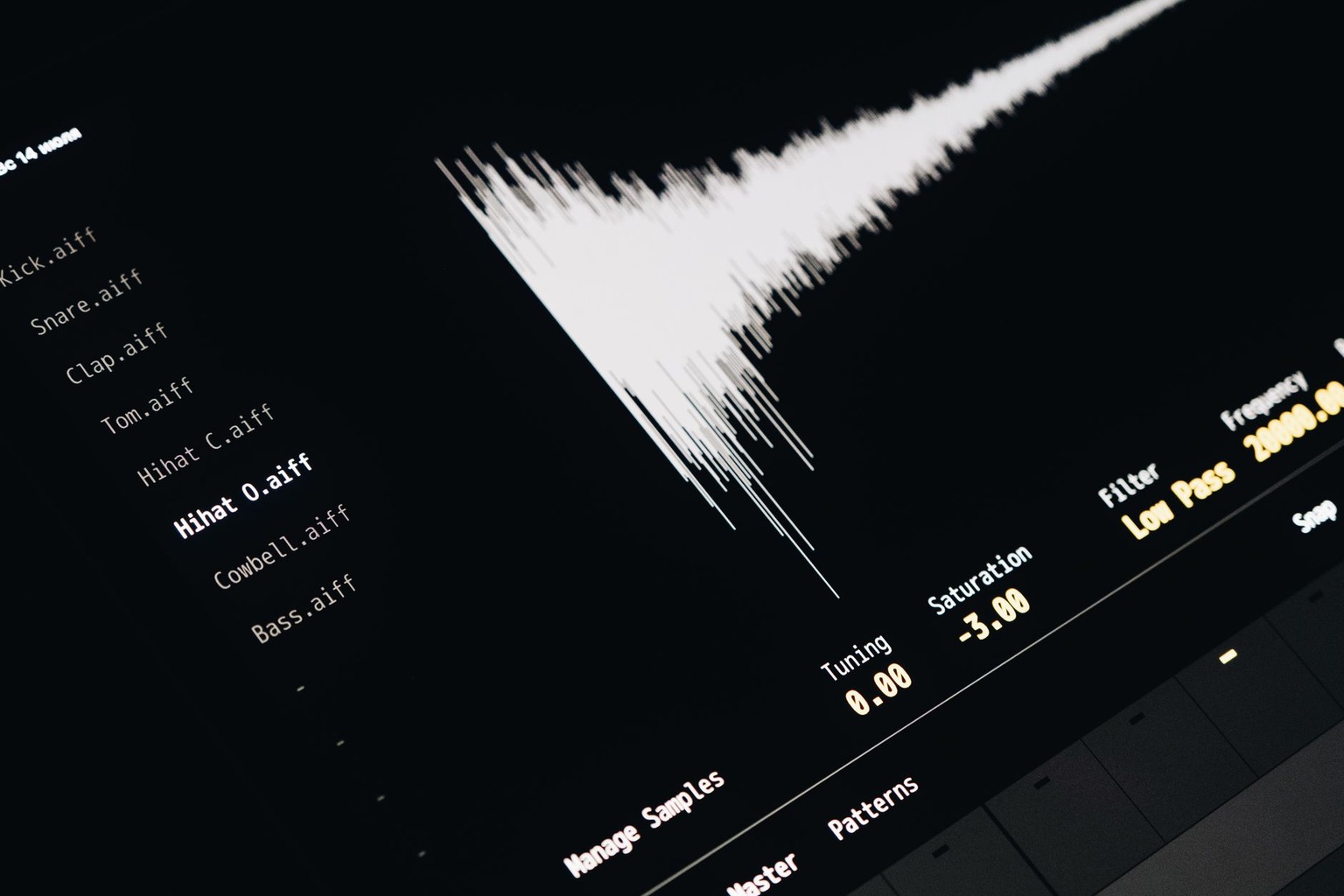
Artists now calibrate this effect deliberately. By modulating the ultrasonic carriers they sculpt the demodulated audio in mid air, creating sound beams that appear to originate from empty space. The technique demands precise thermal management because air absorption at 40 kHz rises sharply with humidity; a 10 percent shift in relative humidity can change absorption by 3 dB per meter, altering the beam’s reach. During the Kitchen run the team monitored hygrometers in real time and adjusted drive voltage to keep the focal zone stable, turning environmental monitoring into part of the performance score.
Psychoacoustic Targeting and Binaural Rendering
Human hearing localizes sources through interaural time differences below 1.5 kHz and interaural level differences above that threshold. Contemporary works exploit this by delivering distinct signals to each ear through bone conduction transducers or tightly focused parametric speakers. In a 2022 piece at the Barbican each visitor wore a lightweight head tracker; the rendering engine updated interaural cues at 480 Hz, locking a virtual voice to a fixed point in space even as the listener turned their head. The illusion held within a two degree tolerance, verified by post session questionnaires where 92 percent of participants reported the source felt externalized.
Beyond localization, masking thresholds shape material selection. A broadband noise floor at 35 dB SPL can mask a 1 kHz tone 15 dB lower, so composers layer sub threshold textures that emerge only when the masker drops. This creates a perceptual archaeology where the audience discovers hidden layers by moving closer to a absorber panel that lowers the local noise floor. The effect is subtle but powerful, visitors report a sense of agency, as if they are excavating the work rather than passively receiving it.
Transducer Arrays and Beamforming Precision
Modern line arrays use digital signal processing to steer lobes electronically without moving parts. A sixteen element column spaced at half wavelength intervals for 2 kHz can place a null within three degrees of a desired angle, suppressing spill into adjacent galleries. At the 2023 Venice Biennale a twelve meter tall array painted the walls with narrow bands of sound, each band carrying a different language recording. The beams crossed at head height, creating a polyglot corridor where a step sideways switched the dominant voice. The DSP latency was held under 0.8 milliseconds, imperceptible to the listener but critical for maintaining phase coherence across the aperture.
Beamforming also enables dynamic focusing. By applying quadratic phase shifts across the array the wavefront curvature can be set to converge at a specific distance, producing a hot spot that moves as the focus distance changes. One artist programmed a focal point to trace a spiral trajectory at 0.2 meters per second, so the sweet spot drifted through the crowd like a slow searchlight. Thermal imaging of the drivers showed voice coil temperatures rising 12 degrees Celsius during the hour long run, prompting the use of forced air cooling integrated into the sculpture’s steel ribs, a practical constraint that became a visual motif.
Environmental Feedback and Adaptive Control
Temperature gradients refract sound just as they refract light. A two degree Celsius difference between floor and ceiling can bend a horizontal wavefront upward by several degrees over a ten meter throw, shifting the intended listening zone. In a 2020 outdoor installation at the Storm King Art Center the crew embedded thermistors every two meters along the propagation path. A Kalman filter estimated the real time sound speed profile and updated driver delays every 200 milliseconds, keeping the focal region locked to a sculptural bench despite afternoon heating cycles.
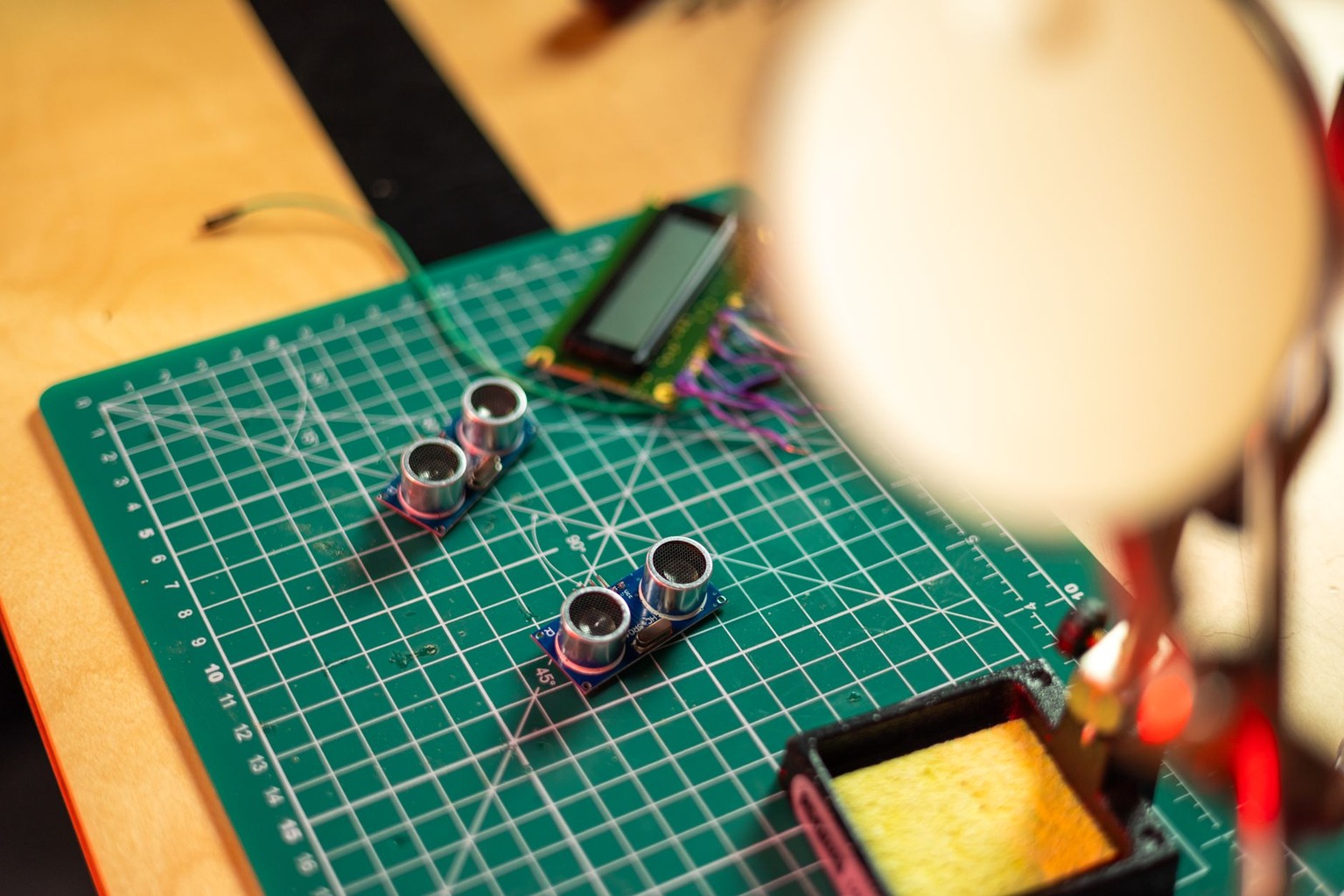
Wind adds a vector component that simple delay compensation cannot fix. At 3 meters per second crosswind a 1 kHz wavefront tilts roughly 0.17 radians, displacing the pressure maximum by 1.7 meters at ten meters range. The Storm King system measured wind with ultrasonic anemometers and applied a steerable beamforming algorithm that countered the tilt by shifting the array’s phase gradient. The result was a stable sound image even during gusts up to 5 m/s, a level of robustness that turned unpredictable weather into a controlled variable rather than a disruption.
Material Interaction and Boundary Engineering
Absorption coefficients vary wildly with frequency and angle of incidence. A 50 mm mineral wool panel absorbs 0.9 at 1 kHz but only 0.15 at 100 Hz. Artists who need low frequency control turn to membrane absorbers, limp mass panels tuned to a target frequency by cavity depth and surface mass. In a recent commission for the MIT Media Lab a series of perforated steel sheets backed by 300 mm cavities created narrow absorption notches at 63 Hz and 125 Hz, taming the room’s strongest axial modes without deadening the midrange. Impedance tube measurements confirmed a reflection coefficient magnitude below 0.2 at the tuned frequencies.
Reflective surfaces can be shaped to focus or disperse energy. A parabolic plaster shell behind a point source collapses the spherical wave into a tight beam, while a fractal diffuser based on a quadratic residue sequence scatters energy across a wide angle with a flat spectral response. The fractal panel used in a 2021 work at the Centre Pompidou measured 2.4 by 2.4 meters and weighed 180 kilograms; its diffusion coefficient stayed above 0.8 from 800 Hz to 4 kHz. The visual texture of the diffuser became part of the aesthetic, its wells and peaks lit by grazing LEDs that revealed the mathematical pattern driving the acoustic performance.

I have spent the past decade exploring the intersections of Freemasonry, art, and science, researching historic manuscripts and architectural symbolism. My work as a freelance writer and independent researcher allows me to share the rich history of knowledge that these traditions embody.